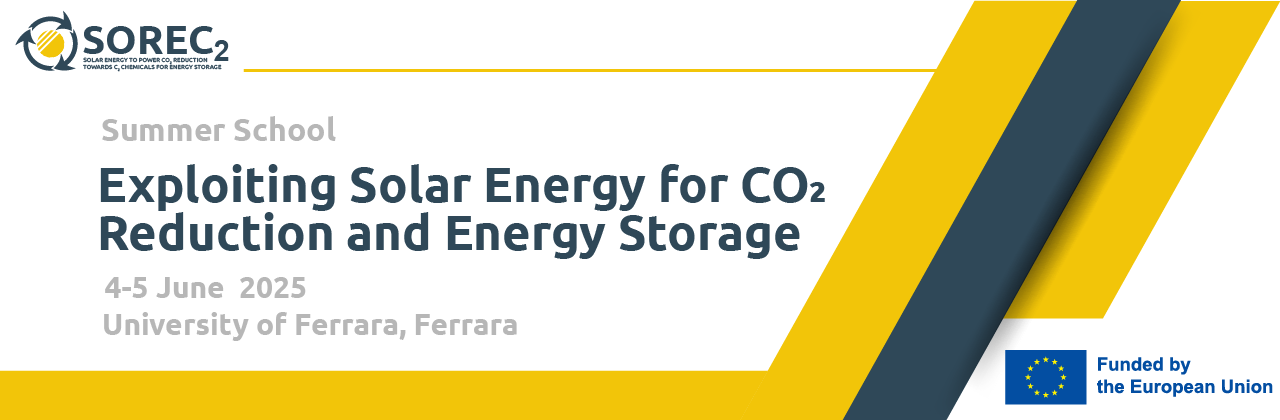
During the Summer School, we will explore the fundamental role of photoelectrocatalysis in understanding and addressing key challenges in solar energy conversion to added value chemicals, with special attention to products obtained through the reduction of CO2.

This Summer School will cover several topics including:

  • (Photo)electrochemistry, examining (semi)conducting materials enabling (photodriven) redox reactions
  • Photovoltaics, focusing on theoretical and experimental approaches to solar enegy storage and conversion to electrical energy
  • Key experimental techniques, highlighting basic and advanced methods for the characterization and mechanistic study of photoactive/catalytic interfaces

Bringing together experts from photovoltaics, photochemistry, material sciences and catalysis, this Summer School will provide participants with an overall perspective on the main approaches currently pursued for the exploitation of solar energy aimed at producing target chemical species.

The event will include lectures where participants will have the opportunity to interact and to delve into the different aspects related to this field of study.

The Summer Schools is organized by the SOREC2 project team, reinforcing its commitment to train the next generation of researchers in the field of renewable energy.

Program

Speakers
Info and Registration

Program

Day 1 – 4 June

  • 09:00h Arrival and credentials distribution
  • 09:30h Welcome –  Serena Berardi (UNIFE)
  • 10:00h Antoni Llobet (ICIQ) – Molecular Redox Catalysts Anchored on Surfaces for Energy Applications | (Abstract)
  • 11:00h Coffe break
  • 11:30h Sixto Giménez (INAM-UJI) – Optimizing metal oxide nanostructures for solar to fuel conversion | (Abstract)
  • 12:30h Paola Ceroni (UNIBO) – Light-harvesting antennae for solar energy conversion | (Abstract)
  • 13:30h Lunch break
  • 14:30h Marcella Bonchio (UNIPD) – A Breath of Sunshine: Oxygenic Photosynthesis by Solar-powered Molecular Architectures |(Abstract)
  • 15:30h Konrad Wojciechowski (SAULE) – Industrial case of flexible perovskite photovoltaics | (Abstract)
  • 16:30h Students Flash talks
    • Alberto Maggliocco (UNIFE)
    • Martina d’Andrea (ICFO)
    • Valentina Gacha (ICFO)
    • David Reyes (UAB)
    • Aureliano Macili (UAB)
    • Anna Ianniello

Day 2 – 5 June

  • 09:30h Francisco Bernal (ICFO) – From sunlight to chemicals: The role of organic photovoltaics | (Abstract)
  • 10:30h Stefano Caramori (UNIFE) – Application of time-resolved techniques in photoelectrochemistry (Abstract)
  • 11:30h Coffee break
  • 12:00h Carolina Gimbert (UAB) – Multicomponent systems for solar fuel generation: coupling catalytic sites with inorganic and organic semiconductors (Abstract)
  • 13:00h Event closure – Serena Berardi (UNIFE)

Speakers

Dr. Serena Berardi – UNIFE

Since December 2021, Serena Berardi is an Associate Professor at the Department of Chemical, Pharmaceutical and Agricultural Sciences of the University of Ferrara, where she was previously a tenure-track Assistant Professor. In 2010 she obtained her PhD in Molecular Sciences (curriculum in Chemical Sciences) at the University of Padova, under the supervision of Prof. Gianfranco Scorrano. After 2 years of post-doctoral activity in the same research group and 1 year at the ISOF-CNR (Ferrara), in 2013 she joined the group of Prof. Antoni Llobet at the Institute of Chemical Research of Catalonia as a Marie Curie Cofund Post-Doctoral Fellow. In 2016 she obtained a Marie Curie Individual Fellowship at the University of Ferrara to work on “Advanced devices for the reduction of carbon dioxide and artificial photosynthesis” (ARCADIA project). Her research interests span the preparation and characterization of semiconductor materials and catalysts with the aim of developing (photo)electrodes for solar energy conversion/storage and for the reduction of carbon dioxide. She has been involved in several national and European projects dealing with the photoinduced water splitting and the formation of value-added products via (photo)electrochemical processes.

Dr. Antoni Llobet – ICIQ

Antoni Llobet is Full Professor at the Institute of Chemical Research of Catalonia (ICIQ). He obtained his PhD at the Universitat Autònoma de Barcelona (UAB) in July 1985, and then moved to the University of North Carolina at Chapel Hill for a postdoctoral stay with Prof. Thomas J. Meyer, until the end of 1987. After a short period again at UAB and at University of Sussex-Dow Corning (UK) he then became Scientific Officer for the Commission of the European Communities, based in Brussels, Belgium (1990-1991). Then he was appointed Senior Research Associate at Texas A&M University in College Station (USA) from 1992 till 1993, working with the groups of Prof. Arthur E. Martell and Donald T. Sawyer. From 1993 till 2004 he joined the faculty of the Universitat de Girona where he was promoted to Full Professor in 2000. At the end of 2004 he joined the faculty of UAB also as Full Professor. In September 2006, he was appointed as Group Leader at the Institute of Chemical Research of Catalonia (ICIQ) in Tarragona. His research interests involve the synergistic combination of molecules and materials for the generation solar fuels via artificial photosynthesis.  At present he is a member of the Editorial Advisory Board of “Catalysis Science and Technology” from the Royal Society of Chemistry and “European Journal of Inorganic Chemistry” from Wiley-VCH and Artificial Photosynthesis” from the American Chemical Society (ACS). He served as EAB for “Inorganic Chemistry” from the ACS during the period January 2015 till December 2016

Dr. Sixto Jiménez – INAM-UJI

Sixto Giménez  is Full Professor at Universitat Jaume I de Castelló (Spain). His professional career has been focused on the study of micro and nanostructured materials for different applications spanning from structural components to optoelectronic devices. During his PhD thesis, he studied the relationship between processing of metallic and ceramic powders, their sintering behavior and mechanical properties. Afterwards, he moved to Katholiek Universiteit Leuven as a postdoctoral researcher, focusing on the development of non-destructive and in-situ characterization techniques of the sintering behavior of metallic porous materials. Since 2008, he works at the University Jaume I and is actively involved in the development of new concepts for photovoltaic and photoelectrochemical devices based on nanoscale materials, with particular focus on understanding the carrier dynamics in these systems. He has participated in different national and international projects and at present coordinates the Pathfinder OHPERA project (grant agreement 101071010).

Dr. Francisco Bernal – ICFO

Dr. Francisco Bernal is a postdoctoral researcher at The Institute of Photonic Sciences (ICFO) in Barcelona, Spain. Born in Mexico, he obtained his Master’s degree in Optics in 2019 from the Instituto Nacional de Astrofísica, Óptica y Electrónica (INAOE) in Puebla. His master’s research focused on the development of high-performance semitransparent organic solar cells, combining theoretical simulations with characterization under real sunlight conditions. He completed his PhD in Photonics at ICFO (cum laude) in 2024 under the supervision of Prof. Jordi Martorell. His doctoral thesis explored photonic-based strategies to overcome intrinsic losses in organic solar cells, with an emphasis on tandem device architectures and nanophotonic configurations aimed at controlling photon emission to surpass energy conversion limits in single-junction systems. During his PhD, he also conducted parallel projects in the fields of ultrafast spectroscopy, and photoelectrochemistry involving organic semiconductors. His current research focuses on understanding the radiative recombination mechanisms in single-junction solar cells, with the goal of proposing novel photonic configurations to overcome established energy conversion limits in solar energy technologies. He has authored peer-reviewed publications in the fields of density functional theory, transparent and tandem organic solar cells, ultrafast spectroscopy, photoelectrochemistry, and single-junction organic photovoltaic devices.

Dr. Marcella Bonchio – UNIPD

Marcella Bonchio   started her scientific career as a research associate of the National Council of Research (CNR), and then in Princeton University (NJ, USA) collaborating with John T. Groves on bio-inspired catalysis. She was promoted to Full-Professor of Organic Chemistry in 2013 at the University of Padova, where she served as Vice-Rector for Research in 2015-2021. Research awards include the 2021 “Lombardia è Ricerca” 1ME prize for breakthrough strategies in Artificial Photosynthesis applied to renewable energy. She is elected Fellow of the European Academy of Sciences (EurASc) since 2020

Dr. Konrad Wojciechowski – SAULE

Konrad Wojciechowski is a Chief Science Officer at Saule Technologies. For the last 9 years he has been leading the development of perovskite PV technology in the company, which grew from an early start-up to the industrial production player. He carried out his PhD studies at the University of Oxford, graduating in 2016. He was part of the team which pioneered the development of metal halide perovskites for optoelectronic applications. Over the years he co-authored over 40 publications, 10 patent families, has managed multiple research projects on the perovskite PV technology and related optoelectronic applications.

Dr. Paola Ceroni – UNIBO

Paola Ceroni (born 1971) got her laurea (cum laude) in chemistry at the University of Bologna (UniBo) in 1995: thesis on photophysics of molecular knots, advisor Prof. Vincenzo Balzani. She got the PhD in Chemical Sciences at the University of Bologna in 1998, working under the supervision of Prof. Sergio Roffia in the field of electrochemistry and spectroelectrochemistry of molecular and supramolecular systems. She was a visiting scientist in the laboratory of Prof. Allen J. Bard at the University of Texas at Austin (USA), financially supported by a grant from NATO Supramolecular Special Programme. She got research fellowships to work at CNR (Institute of Photochemistry and High Energy Radiation, Bologna) and in the Photochemistry and Supramolecular Chemistry group directed by Prof. Vincenzo Balzani. Since 2001 she has a permanent position at the University of Bologna, Department of Chemistry “Giacomo Ciamician”: she is currently full professor in inorganic chemistry. Her current research interests are focused on luminescent nanocrystals, molecular and supramolecular systems for artificial photosynthesis and photocatalysis.

Dr. Stefano Caramori – UNIFE

Stefano Caramori is Full Professor of General and Inorganic Chemistry at the Department of Chemical, Pharmaceutical and Agricultural Sciences at the University of Ferrara since 2020. His main research interests involve the study of molecular systems and materials aimed at converting solar energy into chemical energy (fuel production) or electrical energy. His scientific activity span the following: 1) Synthesis and fundamental studies on redox and spectroscopic properties of coordination compounds, organic sensitizers, and supramolecular charge-separation units; 2) Study of coordination compounds as low-corrosivity electron mediators for regenerative photoelectrochemical cells and 3) Development of nanostructured photoelectrodes based on wide bandgap semiconductors. He actively collaborates with several national and international research groups and companies in the broader field of photoinduced processes.

Dr. Carolina Gimbert – UAB

Carolina Gimbert Suriñach obtained her PhD from the Autonomous University of Barcelona (UAB) under the supervision of Prof. A. Vallribera, working on the development of organocatalytic processes. After one year as Assistant Professor at the same university, she moved to the University of New South Wales (UNSW) to undertake postdoctoral research in the field of bioinorganic chemistry with Prof. S. B. Colbran. Afterwards, she started a second postdoctoral position at the Institute of Chemical Research of Catalonia (ICIQ) in Prof. A. Llobet group. During this time, she developed hydrogen evolution and water oxidation (photo)catalytic systems. Three years later she was promoted to scientific group coordinator in the same group and her research focused on implementing molecular catalysis into water splitting devices. After a short stay in the University of Barcelona (UB) as Serra Húnter Professor in 2020, she moved to the Chemistry Department of UAB early 2021 first as a Ramón y Cajal fellow and then as Associate Professor. Her scientific interests are in the field of photocatalysis as well as organic and hybrid materials with application to artificial photosynthesis.

Practical info

Dates

4-5 June 2025

Venue – 4th June

UNIFE – Complesso Santa Maria di Mortara

Aula F4
Via Fossato di Mortara 19, Ferrara
View in map

Venue – 5th June

UNIFE – Nuovi Istituti Biologici – Polo Chimico Biomedico (Mammuth)

Aula Levi
Via Luigi Borsari, 46 – Ferrara
View in map

Suggested Access Paths

Check here to download the map with the suggested access paths

Language

English

Registration

You can register here before 23 May 2025

Target

Master Students (final years)
PhD students
Post-docs

Price

Free of charge

Contact

Dra. Serena Berardi (UNIFE)

Contact

Dra. Joana Ibáñez (ICFO)

Contact

Discover Ferrara

The city of Ferrara is nestled in the heart of the Emilia-Romagna region. A UNESCO World Heritage site, the city proudly names itself the capital of the Renaissance. Beyond its walls, a diverse landscape unfolds, including the Po Delta with its unique ecosystems and picturesque towns. Get more practical info to plan your visit to the city of Ferrara and its province by clicking the following button.

Organization

The Summer School is hosted and locally co-oganized by the University of Ferrara (UNIFE) on behalf and in the framework of the SOREC2 project, funded by the Horizon Europe programme under Grant Agreement 101084326.

Funded by:

Organized by:

Hosted by: